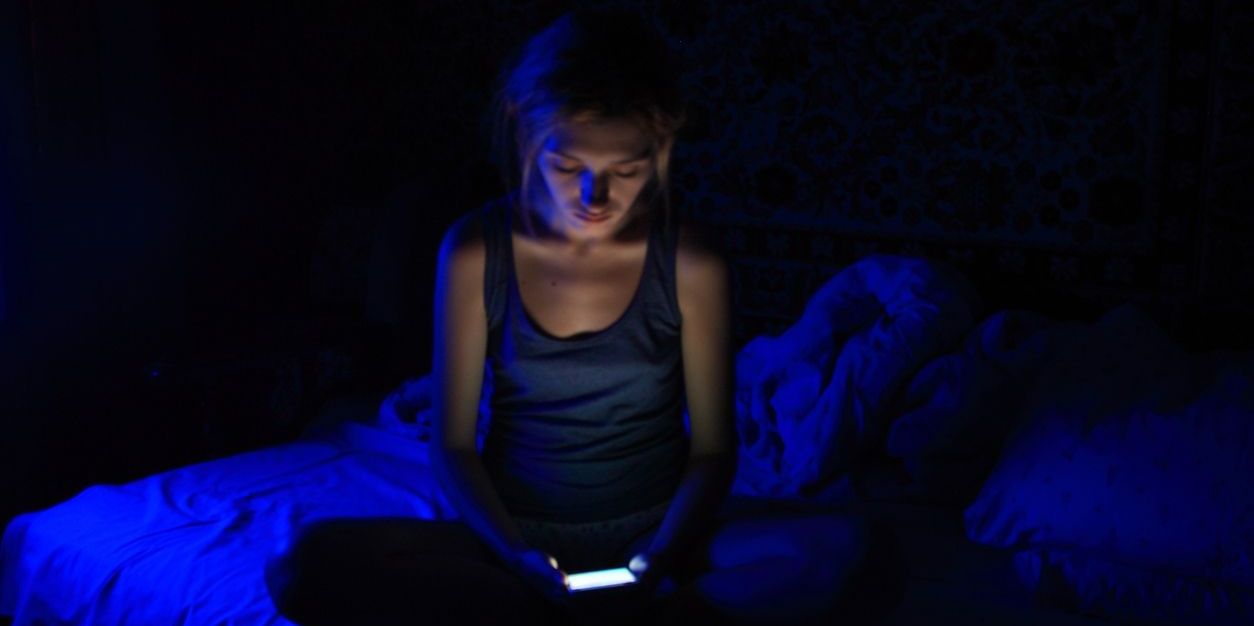
Summary: Yes, new research shows that reducing blue light during residential mental health treatment can help improve treatment outcomes in important areas: overall improvement, severity of illness, aggression, and violent incidents during treatment.
Key Points:
- The connection between blue light and sleep disturbance is well-established: exposure to blue light in evening hours before bedtime has a negative effect on sleep quality and duration.
- Blue light comes from: the sun, fluorescent lights, LED lights, and screens on digital devices including smartphones, laptops, and tablets.
- Evidence on the impact of blue light on mental health is mixed and contradictory: some studies identify benefits, while others identify negative effects.
- New research examines the effect of blocking blue light at specific times in specific treatment environments
The Impact of Blue Light on Mental Health
Around the world, particularly in technology-enabled/computer/internet connected societies like the United States, people spend more time looking at screens in the evening hours than ever before. In earlier generations, screen time in the evening hours meant a couple hours of television, which gradually increases to several hours for many people.
However, with the arrival of laptops, smartphones, and tablets, people now regularly take their screens to bed with them. This increases overall exposure to blue light and brings the time of exposure closer to bedtime. It’s true that before portable screens, some people had TV sets in their bedroom, but this was not a universal thing: most homes didn’t. Now, nearly everyone has a digital device, and many have a habit of hanging out with them on/in bed, checking work emails one last time, scrolling news or social media feeds, watching videos, or reading whatever interests them.
Evidence shows this can have a negative effect on mental health. However, most research shows the negative mental health effects may be indirect. Using digital screens near bedtime is associated with sleep disturbance, loss of sleep, and increased risk of insomnia and the negative effects of sleep deprivation. Negative effects of insomnia and sleep deprivation may include:
- Major depressive disorder (MDD)
- Generalized anxiety disorder (GAD)
- Post-traumatic stress disorder (PTSD)
- Schizophrenia (SCZ)
- Alcohol/substance misuse
While blue light is connected to sleep disturbance/deprivation, which in turn is associated with mental health outcomes, research on a direct connection between blue light and mental health remains unclear.
For instance:
- A study published in 2022 shows evening exposure to blue light increases overall wellbeing in young adults.
- A study published in 2023 shows exposure to blue light around bedtime hours has a negative effect on cognition and memory, but not on mood.
- An experiment conducted in 2025 shows exposure to blue light in the evening is associated with an improved sense of self.
A new study approaches this question from a different angle: what happens when clinicians reduce blue light exposure during nighttime hours at a residential mental health treatment center?
Reducing Blue Light During Mental Health Treatment: Does it Make a Difference?
In the publication “Clinical Benefits of Modifying the Evening Light Environment in an Acute Psychiatric Unit: A Single-Centre, Two-Arm, Parallel-Group, Pragmatic Effectiveness Randomized Controlled Trial,” a team of clinicians and researchers examined this question. Here’s how they frame and describe the experiment:
“The impact of light exposure on mental health is increasingly recognized. Modifying inpatient evening light exposure may be a low-intensity intervention for mental disorders, but few randomized controlled trials (RCTs) exist. We report a large-scale pragmatic effectiveness RCT exploring whether individuals with acute psychiatric illnesses experience additional benefits from admission to an inpatient ward where changes in the evening light exposure are integrated into the therapeutic environment.”
One interesting thing about this study is the lengths researchers, clinicians, and hospital designers went to conduct the study. Here’s what they did:
- Constructed a new psychiatric unit that included 2 separate wards, identical in the following ways:
- Layout
- Staffing
- Facilities
- Installed one ward with standard lighting, and one with blue-depleted, or blue reduced
- Recruited 476 patients to receive the same care routine, placing half in the standard light ward and half in the blue reduced light ward.
The research team collected data on primary and secondary outcomes:
- Primary: length of stay in acute care
- Secondary outcomes assessed specific clinical outcomes:
- Improvement during treatment, measured by The Clinical Global Impressions Scale–Improvement (CGI-I) 0.28 difference
- Illness severity at discharge, measured by a subscale of the CGI, called the CGI-S, which measures severity of illness at a point in time, rather than improvement over time.
- Aggressive behavior during treatment, measured by the Broset Violence Checklist (BVC)
- Violent incidents, measured by the Staff Observation Aggression Scale-Revised (SOAS-R)
- Side effects and patient satisfaction, determined by observation.
- Probabilities of suicidality
- Need for supervision due to suicidality
- Change from involuntary to voluntary admission
Let’s take a look at the results.
Does Reducing Blue Light During Mental Health Treatment Improve Outcomes?
To put these results in perspective, we should note that this experiment occurred in an acute inpatient mental health treatment hospital, with patients most often admitted during mental health crises. Acute inpatient hospitals typically support patients in severe distress, often at risk of harm to themselves or others, with the goal of achieving safety and stabilization before stepping down a level of care or release to the home and/or community treatment.
Here’s what they found:
- Primary outcome, days spent in treatment:
- Blue light: 7.1 days
- Standard light: 6.7 days
No meaningful difference between groups.
- Improvement during treatment (The Clinical Global Impressions Scale–Improvement, CGI-I).
- Blue light group average score: 2.13
- Standard light group average score: 1.85
A moderate but clinically meaningful improvement for patients in the blue light group.
- Illness severity at discharge (CGI-S)
- Blue light group average score:: lower illness severity 3.37
- Standard light group average score: 3.53
Moderate but clinically meaningful improvement for patients in the blue light group.
- Aggressive behavior during treatment (Broset Violence Checklist, BVC)
- Blue light group average score: 0.04
- Standard light group average score: 0.29
A moderate but clinically meaningful improvement for patients in the blue light group.
- Violent incidents (Staff Observation Aggression Scale-Revised, SOAS-R)
- Blue light: 0.31
- Standard light: 3.30
Statistically significant and clinically meaningful improvement for patients in the blue light group.
Data showed no differences in the secondary outcomes for side effects and patient satisfaction, probabilities of suicidality, need for supervision due to suicidality, and change from involuntary to voluntary admission.
We’ll discuss the data further, below.
Simple Intervention Yields New Avenues for Research
Here’s how the researchers describe their results:
“There were no differences in length of stay, but we observed that patients admitted to the blue-depleted light environment had additional clinical improvement and displayed less aggressive behavior during admission.”
Further, they observed that although their primary hypothesis was disproved, the short duration of the exposure to intervention – meaning patient only had blue light in the evenings for less than a week – led to clinically meaningful results in clinically important areas, i.e. improvement, severity, aggression, and violent incidents. In addition, the simplicity and “unobtrusiveness” of the intervention – a change in lighting in the evening – means it could be a relatively inexpensive and efficient way to improve outcomes in a mental health treatment setting. The team recommended further avenues for follow-up research:
- Test intervention in different treatment environments
- Assess impact of dosage, i.e. length of blue-depleted light exposure, on outcomes
- Test intervention on different patient populations.
We agree: if a simple intervention of this nature can improve outcomes over a short duration with an acutely distressed population, it’s important to follow up, and learn whether less acute populations in less immersive treatment situations may also experience clinical benefit. If research indicates it can, then we’ll know we have another evidence-based tool to improve overall outcomes for our patients.
Additional Resources: Sleep and Mental Health
To learn more about the relationship between sleep and mental health, please read these articles on our blog:
Sleep and Mental Health: What’s the Relationship?
Does Lack of Sleep Increase Risk of Depression?
Can Exercise Help Reduce Insomnia?
If you need support for mental health problems related to sleep disturbance, sleep deprivation, and/or insomnia, please contact us at Crownview Psychiatric Institute: we can help.

 Gianna Melendez
 Jodie Dahl, CpHT